Practical Use:
Historically, pilgrims used the concave scallop shell as a lightweight, unbreakable bowl for food and a scoop for gathering water from streams.
Historical Proof:
Because the scallop is native to the shores of Galicia in northwestern Spain, medieval pilgrims would complete their trek by walking all the way to the Atlantic coast (often at Finisterre) to collect their shell. Wearing it on their return journey proved they reached the end of the pilgrimage.
Route Navigation:
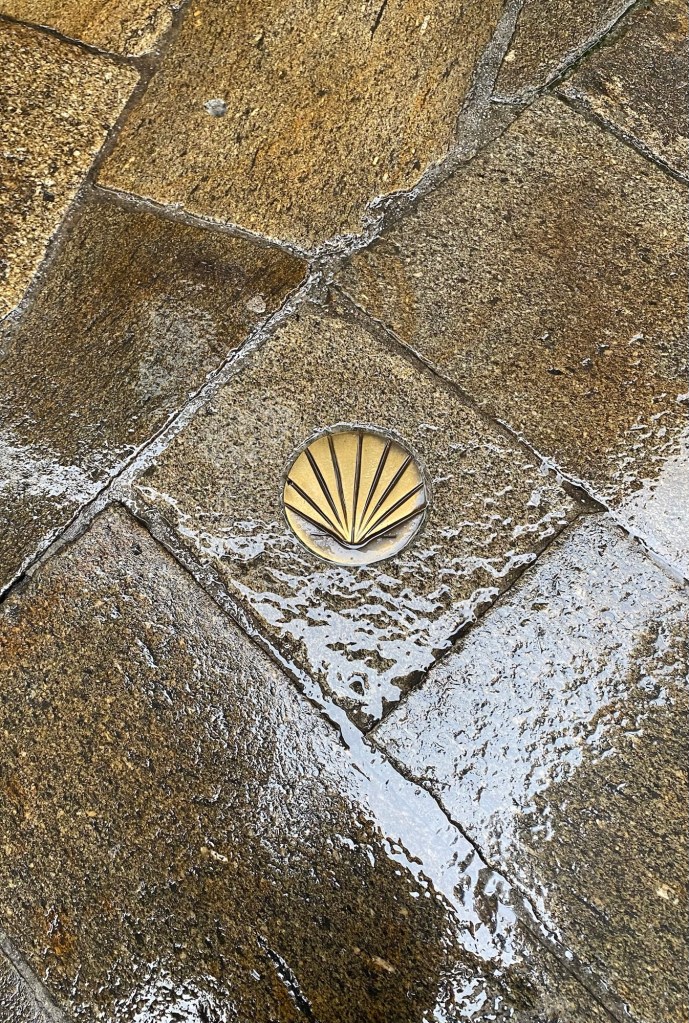
Today, stylized yellow scallop shells mark the physical routes. When walking through intersections, the radiating lines of the shell pointing forward signify the path to Santiago de Compostela.
Symbol of Unity & Metaphor:
The converging lines on the shell symbolize the many different starting locations and paths pilgrims take across Europe, all leading to a single destination. It also serves as a spiritual metaphor for a traveler’s own life journey.
The shell is also deeply tied to Jacobean folklore. According to one popular legend, when the ship carrying the remains of St. James the Apostle (Santiago) was caught in a severe storm, his undamaged body washed ashore completely covered in scallop shells.
 Rhonda’s Travel Blog
Leave a comment